
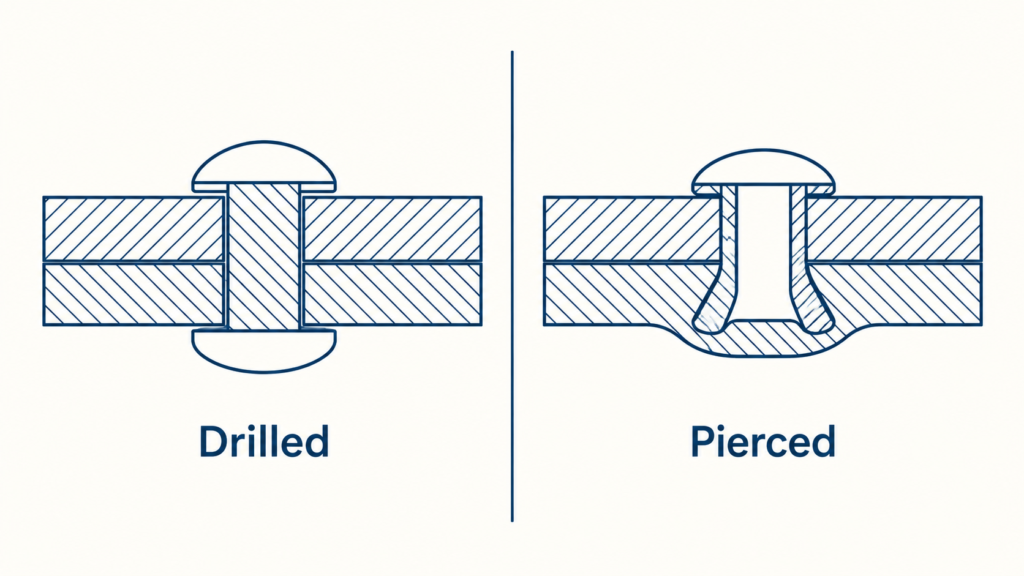
Why is an old railway bridge covered in rows of round metal heads, while a steel frame going up on site this year has almost none of them?
The answer sits in one of the oldest topics in the steel structures syllabus. For most of the nineteenth and early twentieth century, rivets were how steel members were connected to each other. Plates were drilled or punched, a rivet was heated until it glowed, driven through the hole, and hammered until a second head formed. As the rivet cooled it contracted and pulled the plates together. Students still study these joints because the design logic behind pitch, gauge, bearing and tearing carries directly over to bolted connections, and because a large number of riveted bridges and industrial buildings are still standing and still need assessment.
Riveting also did not vanish from engineering. It moved into a different form. In manufacturing, self-pierce riveting joins stacked sheets cold, with no drilled hole and no heat at all, using a matched combination of setter, rivet and die; there is good information here on how those three parts work together in a production system.
How a riveted joint is put together
A riveted connection is a permanent joint. Once the second head is formed, removing the rivet means destroying it, which is one reason the method suits structures that will not be dismantled and disqualifies it wherever future disassembly matters.
Before any calculation, the terminology has to be clear, because almost every exam question depends on it.
| Term | What it means |
| Gross diameter | The diameter of the driven rivet, which fills the hole and is slightly larger than the nominal rivet before driving. Design calculations use this value, not the nominal one |
| Pitch | Centre-to-centre spacing of rivets measured along a line in the direction of the applied load |
| Gauge | Distance between two adjacent rows of rivets, measured across the direction of the load |
| Margin | Distance from the centre of the nearest rivet to the edge of the plate |
| Joint efficiency | Strength of the riveted joint divided by the strength of the same plate with no holes in it |
For preliminary sizing, Unwin’s formula gives the rivet hole diameter as roughly six times the square root of the plate thickness, with both values in millimetres. It is an approximation and codes govern the final choice, but it is the number most students are asked to reproduce.
Lap joints and butt joints
In a lap joint the two plates overlap, so their centre lines do not coincide. Pull on that arrangement and the load path has a kink in it, which puts the rivets into bending as well as shear and tends to make the plates rotate.
A butt joint keeps the main plates in the same plane and covers the gap with one or two cover plates. With two cover plates, the rivets are in double shear rather than single shear, and the eccentricity that troubles lap joints largely disappears. That is why butt joints are preferred for anything carrying serious load, and why lap joints are usually reserved for lighter or secondary work.
The four ways a riveted joint fails
Design does not chase one failure mode. It checks several and lets the weakest one govern.
The rivet itself can shear across the plane between the plates. The plate or the rivet can crush where the shank bears against the side of the hole, which is bearing failure and depends on the gross diameter and the plate thickness. The plate can tear across the reduced section between two holes, since drilling the holes removes material exactly where the tension is. Finally, if the margin is too small, the material between the last rivet and the plate edge simply shears out or splits.
Why efficiency matters
Because holes remove metal, a riveted joint is always weaker than the solid plate it interrupts. Efficiency expresses that loss as a ratio, and improving it usually means rearranging rivets rather than adding more of them. Staggering rows into a zig-zag pattern, for example, lengthens the tearing path across the plate without changing the number of rivets at all.
Why bolts took over, and where riveting stayed
High-strength bolts displaced structural rivets in the middle of the twentieth century, mostly for reasons of labour and site practice. Hot riveting needed a furnace on site, a skilled gang working in sequence, considerable noise, and open flame at height. Bolting needs a smaller crew, produces a joint that can be inspected by measurable means, and can be undone. Rivets still appear in current reference material for a practical reason: AISC Design Guide 17 includes a short treatment of rivets specifically because so many riveted structures remain in service and their adequacy has to be verified.
Cold riveting in modern manufacturing
Meanwhile the automotive industry ran into a problem that welding could not solve. Joining aluminium to high-strength steel with heat produces brittle intermetallic compounds at the interface, so a joining method that stays cold became necessary as vehicle bodies turned into mixed-material assemblies. Self-pierce riveting answers that: a hard rivet punches through the upper sheet, then flares outward inside the lower sheet without breaking through it, creating a mechanical interlock. No hole is drilled first, no filler metal is added, and no fumes are produced. The same technique is used on electric vehicle battery trays and enclosures, where the joint has to seal as well as hold.
For anyone comparing the two, the underlying mechanics are recognisably the same. Shear, bearing and edge distance still decide whether the connection survives, whether the rivet was glowing red in 1910 or driven cold by a robot last week. If quality checking on fabricated joints is the part you want to follow up, the site’s note on inspection equipment for fabrication shops covers the measurement side of the same problem.